 Back to main page

The Dachshund
General Information
Country of Origin: Germany.
Date of publication of the official valid standard: 04.09.2019.
Utilization: Hunting dog for above and below ground work.
FCI Classification: Group 4 Dachshunds. With working trial.
Brief Historical Summary
The Dachshund, also called Dackel or Teckel, has been known since the Middle Ages. From the Bracke, dogs especially suitable for hunting below ground were consistently bred. From these short-legged dogs, the Dachshund evolved and is recognised as one of the most versatile hunting breeds. It also shows excellent performance above ground, hunting while giving tongue, flushing, and tracking wounded game. The oldest club devoted to the breeding of Dachshunds is the "Deutsche Teckelklub e.V.", founded in 1888. For decades the Dachshund has been bred in three different sizes (Standard Dachshund, Miniature Dachshund, and Rabbit Dachshund) and in three different coat varieties (Smooth-haired, Wire-haired, and Long-haired), resulting in nine varieties.
General Appearance
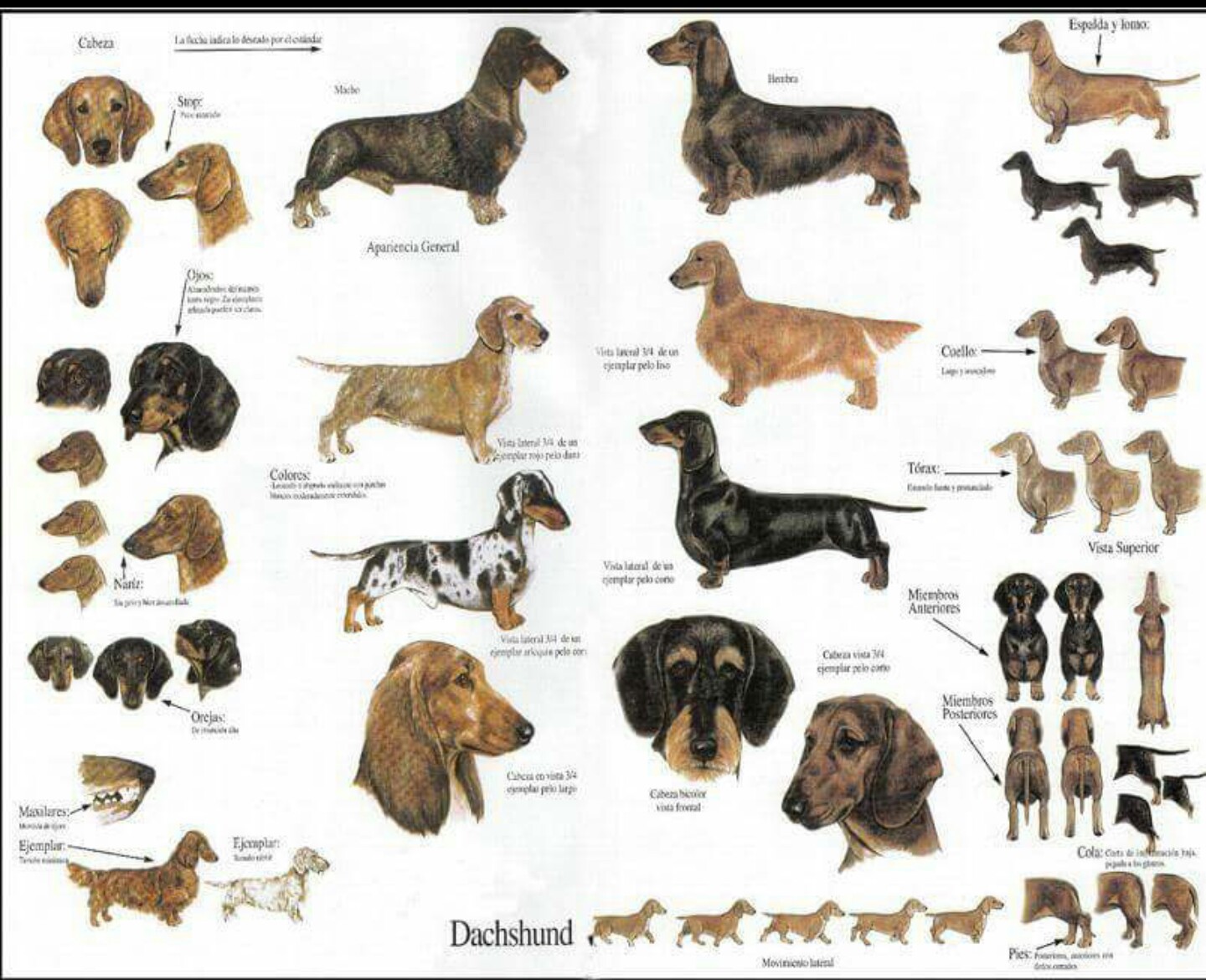
Low, short-legged, elongated but compact build, very muscular, with cheeky, challenging carriage of the head and alert facial expression. His build allows agile, quick work above and below ground. Sexual dimorphism is well pronounced.
Important Proportions
With ground clearance of about one third of the height at the withers, the body length (from the point of the manubrium of the sternum to the point of the ischial tuberosity) should be in harmonious relation to the height at the withers, about 1.7-1.8:1.
Behaviour / Temperament
Friendly by nature, neither nervous nor aggressive, with even temperament. Passionate, persevering, fast hunting dog with an excellent nose.
Head
Elongated as seen from above. As seen in profile, tapering uniformly towards the nose leather, yet not pointed. Superciliary ridges are clearly defined. Nasal cartilage and bridge of the nose are long and narrow.
- Cranial Region: Rather flat, gradually merging into the slightly arched bridge of nose. Occipital protuberance not overly pronounced. Stop is only slightly indicated.
- Nose: Well developed with well-opened nostrils.
- Muzzle: Long, sufficiently broad and strong. Can be opened wide, cleft up to the vertical of the eyes.
- Lips: Tautly fitting, well covering the lower jaw.
- Jaws / Teeth: Well developed jaws. Scissor bite, even and closing tightly. Ideally complete set of 42 teeth according to the formula for the dog mouth, with strong canines fitting exactly into each other.
- Eyes: Medium size, oval, set well apart, with clear, energetic and yet friendly expression. Not piercing. Colour luminous dark reddish-brown to black-brown in all coat colours of the dogs. Wall eyes, fish or pearl eyes in dapple dogs are not desired, but shall be tolerated. Eye lids are well pigmented.
- Ears: Set on high, not too far forward. Sufficiently long, but not exaggerated. Rounded, not narrow, pointed or folded. Mobile, with front edge lying close to the cheek.
Neck and Body
Neck: Sufficiently long, muscular. Taut skin on the throat. Nape slightly arched, carried freely and high.
- Topline: Blending harmoniously from the neck to the slightly sloping croup. The withers are pronounced.
- Back: Behind the high withers, the topline runs from the thoracic vertebrae straight or slightly sloping towards the rear. Firm and well muscled.
- Loins: Strongly muscled, sufficiently long.
- Croup: Broad and sufficiently long, slightly sloping.
- Chest: Sternum well developed and so prominent that slight depressions are visible on either side. The ribcage, seen from the front, is oval. Seen from above and the side, it is spacious, giving plenty of space for heart and lung development. Ribs carried well back. With correct length and angulation of shoulder blade and upper arm, the front leg covers the lowest point of the sternal line in profile. Dewlap is not pronounced.
- Underline and belly: Slight tuck up. The chest passes continuously into the belly in a smooth line.
Tail and Limbs
Tail: Set on not too high, carried in the continuation of the topline. A slight curve in the last third of the tail is permitted.
Forequarters
Strongly muscled, well angulated. Seen from the front, dry front legs, standing straight with good strength of bone; the feet pointing straight forward, positioned at the lowest point of the chest.
- Shoulders: Well defined muscles. Long sloping shoulder blade (approx. 90 degrees to upper arm), fitting close to chest.
- Upper arm: Equal in length to shoulder blade, set at almost a right angle. Of strong bone and well muscled, close fitting to ribs but free in movement.
- Elbow: Turning neither in nor out.
- Forearm: Short, yet so long that the dog's ground clearance is one third of its height at the withers. As straight as possible.
- Front feet: Toes close together, well arched, with strong, resistant, well-padded pads and short, strong nails. The fifth toe has no function.
Hindquarters
Strongly muscled, in correct proportion to forequarters. Strong angulation of stifles and hock joints. Hind legs standing parallel, neither close nor too wide apart.
- Upper thigh: Should be of good length and heavily muscled.
- Stifle (Knee): Broad and strong with pronounced angulation.
- Lower thigh: Short, at almost a right angle to upper thigh. Well muscled.
- Hock joint: Strong, with strong tendons and taut skin.
- Hind feet: Four closely knit, well arched toes. Resting firmly on strong pads.
Gait / Movement and Skin
Gait / Movement: Ground covering, flowing and energetic, with far reaching front strides without much lift, strong drive and slightly springy transmission to the topline. The tail should be carried in harmonious continuation of the topline, slightly sloping. The front and hind legs have parallel movement.
Skin: Tautly fitting, well pigmented.
Coat Varieties and Colours
1. Smooth-haired Dachshund
Coat: Short, dense, shiny, smooth fitting, tight and harsh. Not showing any bald patches anywhere. The tail is fine, fully but not too profusely coated. Somewhat longer guard hair on underside is not a fault.
- Solid colour: Red. Interspersed black hairs are permissible. However, a clean dark colour is preferable. A small white spot (up to 3 cm in diameter) is only permissible on the chest. Nose, nails and pads are black; reddish-brown is not desirable.
- Two-coloured: Deep black or brown, each with tan markings (the darker, the better and as clean as possible), over eyes, at the sides of the muzzle and of the lower lip, on inner edge of ears, on forechest, on inside and rear side of legs, on feet, around the anus and from there reaching to about one third or one half of the underside of the tail. Nose, nails and pads are black in black dogs, brown in brown dogs. Too widespread, as well as insufficient tan markings are highly undesirable.
- Dapple (Merle): The basic colour is always the dark colour (black or brown). Exception: red dapples (red with dark spots). Desired are irregular grey or beige patches (large patches not desirable). Neither the dark nor the light colour should predominate.
- Brindle: The colour of the brindle Dachshund is red with dark brindle.